

HOW WETRAIN WORKS
From Training Requirement to a Program That Works for Your Team
Every organisation starts somewhere different. WeTrain begins by understanding what your people need to do better, then shapes the trainer, content, examples and delivery around that requirement.
Delivering Workplace Training
People Trained
Specialist Trainers
On-Site & Live Online
IT STARTS WITH YOUR TEAM
We Don’t Start With a Course. We Start With What Needs to Improve.
The first conversation is about your people and the situations they need to handle. WeTrain uses that context to identify the training priorities and the format that makes sense for your organisation.
You do not need to know the exact course title before contacting WeTrain. Tell us what your people need to do better and we can help identify the right training approach.
THE PEOPLE
Who needs the training?
Participant roles, responsibilities, existing experience and the common situations people encounter at work.
THE PRIORITIES
What needs to improve?
Current challenges, desired workplace outcomes and where the team needs greater capability or confidence.
THE PRACTICALITIES
What needs to fit?
Group numbers, locations, preferred timing and whether you need one session or a wider development program.
SEE HOW WETRAIN TRAINS
Practical Training, Not a Day of Slides
How WeTrain Your Team
WeTrain programs are designed around participation. Depending on the topic, participants may work through scenarios, practise conversations, discuss real workplace situations, complete activities and apply techniques during the session.
The trainer’s role is not simply to present information. It is to help participants understand the skill, practise it and connect it to their work.
THE WETRAIN PROCESS
A Clear Path From First Conversation to Next Steps
Eight practical steps to shape, coordinate and deliver training around your requirement.
Understand the Requirement
WeTrain speaks with your organisation to understand the people, workplace and outcome required. We discuss who will attend, the situations they encounter and what they need to do better.
Recommend the Right Training Approach
We identify a suitable existing program, a tailored combination of topics or a broader development format. The recommendation takes account of your priorities, audience and time available.
Match the Trainer
We select a specialist trainer around the subject, participant experience and seniority, industry context where relevant, location and delivery requirement.
Tailor the Program
The examples, scenarios, activities, emphasis and terminology are shaped around your organisation. Useful workplace situations and existing processes can help make the content relevant.
Confirm Delivery
We clarify participant numbers, dates, timing, venue, room setup, live-online requirements and other practical details so your team knows what to expect before the session.
Deliver the Training
Participants learn through practical discussion, exercises, scenarios and workplace application. Where appropriate, they identify personal actions or shared team commitments to take back to work.
Evaluate the Session
We gather appropriate participant feedback and review the session against the agreed training objectives. This helps identify what participants found useful and where further development may be needed.
Support the Next Step
Where required, we recommend follow-up sessions, further capability areas, repeat cohorts or a wider training program. The next step depends on your team’s needs and the scope agreed with your organisation.
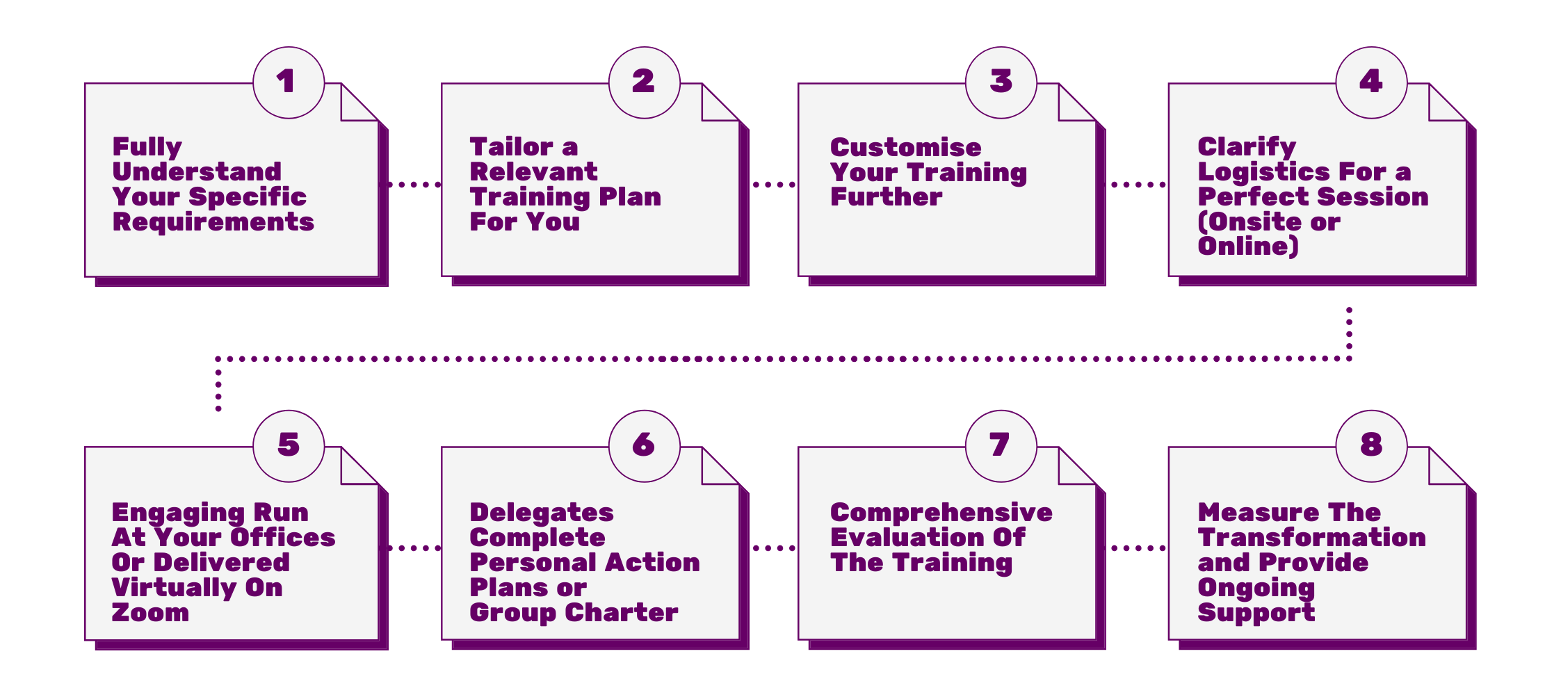
The original WeTrain process
The original eight-step graphic is included here as a visual reference. The steps above explain how the process applies to your organisation today.
WHAT DOES TAILORED ACTUALLY MEAN?
More Than Putting Your Logo on a Slide Deck
Tailoring is about making the training useful to the people in the room. WeTrain can adjust what is covered and how it is practised to suit your workplace.
Your People
- Participant roles and leadership responsibilities
- Existing experience and confidence
- Different audiences within the organisation
Your Workplace
- Real workplace scenarios and organisation-specific examples
- Internal terminology and existing processes
- Customer, client and community interactions
Your Priorities
- Common communication challenges
- Topics that need greater emphasis
- Time available and the most useful activities
01
Same Topic, Different Audience
Communication Skills for frontline employees will not use the same examples as Communication Skills for senior managers.
02
Same Capability, Different Industry
Difficult customer scenarios in healthcare will differ from those in transport, government or hospitality.
03
Same Organisation, Different Groups
Frontline employees, team leaders and managers can share a common development objective while receiving content suited to their responsibilities.
THE RIGHT TRAINER MATTERS
Match the Facilitator to the People in the Room
With a network of 75+ specialist trainers, WeTrain can match the facilitator to the training requirement and the audience. The right fit considers both subject knowledge and the way the group needs to learn.
What We Consider
- Subject expertise and facilitation experience
- Participant seniority and experience
- Industry familiarity where relevant
- Group style and training objectives
- Location and type of delivery
THE WETRAIN INSTITUTE
Trainers representing WeTrain also participate in WeTrain’s internal trainer development and quality process.
WHAT TRAINING LOOKS LIKE
Learn It. Practise It. Connect It to Work.
01
Learn
Understand the practical skill, approach or framework.
02
Practise
Apply it through realistic activities and scenarios.
03
Discuss
Explore how it connects to participants’ actual workplace.
04
Apply
Leave with clear actions participants can use after the training.
DIFFERENT DELIVERY REQUIREMENTS
One Team or a Larger Training Requirement
The program can grow around your organisation. Start with the format your team needs, then coordinate additional groups, audiences or locations where required.
01
One Team
A focused workshop for one group.
02
Multiple Groups
Repeat a consistent program across several cohorts.
03
Different Audiences
Adapt the program for employees, supervisors and managers.
04
Multiple Locations
Coordinate delivery across metropolitan and regional teams.
05
Multi-Session Program
Develop capability over several sessions.
06
National Rollout
Coordinate trainers, groups and locations around a consistent program.
On-site and live-online delivery can be discussed around your locations, group requirements and preferred timing.
WHAT HAPPENS NEXT?
Training Should Connect Back to the Workplace
The session is a starting point for applying the skills at work. WeTrain can help identify practical next steps, with the level of follow-up shaped around the agreed training requirement.
Review the Session
Participant evaluation helps identify what was useful, how the session met its objectives and where further learning may be needed.
Agree on Practical Actions
Where appropriate, participants can complete personal action plans or agree on group commitments or a team charter. Managers can reinforce those actions in everyday work.
Plan Further Development
Follow-up development may include repeat groups, additional sessions or recommendations for further capability areas. These next steps are discussed around your organisation’s priorities.
CLIENT EXPERIENCE
Different Requirements. A Practical Approach.

TAILORING ACROSS MULTIPLE GROUPS
Melton Council
A tailored Customer Service program was delivered across more than 400 staff. Daniel Hogan’s feedback describes consistent, interactive sessions that supported the introduction of a customer service charter.

NATIONAL DELIVERY
ACU National
ACU engaged WeTrain to conduct training sessions with staff nationally. Learning and Development Manager Monique Kinerson described a positive participant response and practical workplace application.
PRACTICAL TRAINER DEVELOPMENT
Train the Trainer
CSIRO’s feedback on a two-day Train the Trainer workshop described learning to add interaction, simplify content and focus on the learner’s needs. Regional Health Manager Danielle Somers highlighted the move from presenting information to training people.
WHY THE PROCESS WORKS
Workplace training experience since 1998.
People trained.
Specialist trainers.
Internal trainer development and quality process.
On-site and live-online capability.
HOW WETRAIN WORKS FAQs
Questions Before You Get Started
Do we need to know exactly which training course we need?
No. You can start with the capability or workplace issue you want to improve. Tell us who needs training, what is happening now and what you want people to do better. WeTrain can then help identify a suitable program, combination of topics or development format.
How much can WeTrain tailor a program?
Tailoring can include the audience, examples, activities, emphasis, scenarios, terminology and delivery format. We discuss your priorities, the participants’ experience and the time available, then agree on the most useful content and level of tailoring for the requirement.
Can WeTrain use situations from our organisation?
Yes, where appropriate. Real workplace situations can make the discussion and practice more relevant. We can discuss which examples are useful, what information is needed and how confidential details should be handled or anonymised before they are used in training.
Can you train different employee groups differently?
Yes. Frontline employees, supervisors and managers can receive different versions of a program while working towards shared objectives. The examples, activities and level of detail can reflect each group’s responsibilities and experience.
Can WeTrain deliver across several locations?
Yes. WeTrain can coordinate multiple groups and training across metropolitan and regional locations in Australia. On-site, live-online or a combination of formats can be discussed around participant numbers, locations, timing and the scope of the rollout.
What happens after the training?
Participant evaluation helps review the session against the agreed objectives. Where appropriate, participants leave with personal actions or shared group commitments to apply at work. Further sessions, repeat groups or additional capability development can be discussed where needed.
START WITH THE REQUIREMENT
Tell Us What Your People Need to Do Better
You don’t need to arrive with a finished training brief. Tell us about your team, the workplace challenge and what you want to improve. We’ll help determine the right training, trainer and delivery format.